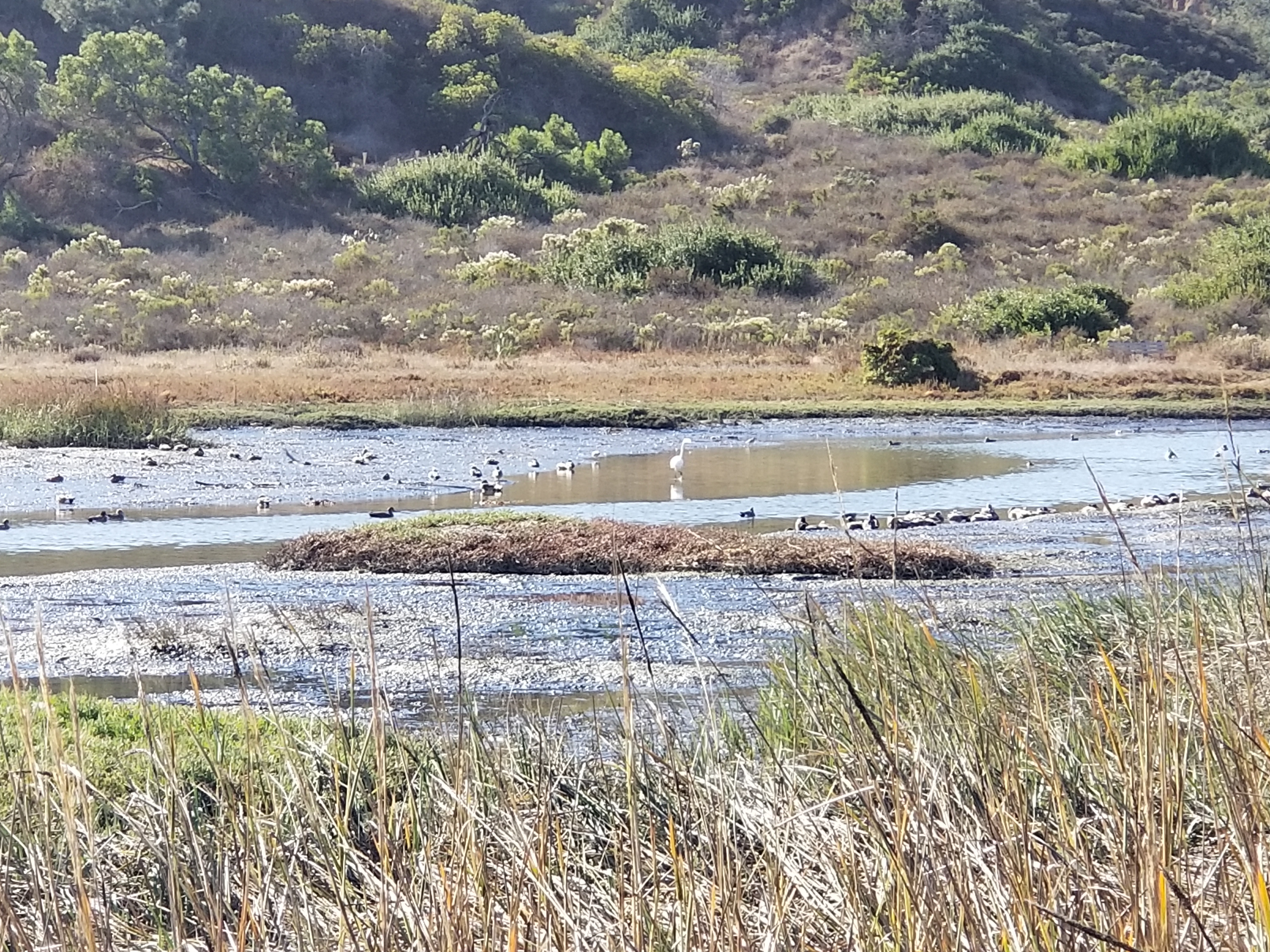
About: San Elijo Lagoon is a 960-acre shallow-water estuary located 20 miles north of the city of San Diego, between the coastal cities of Encinitas and Solana Beach, and is a State of California designated Ecological Reserve. It is divided by Highway 101 and the coastal rail line to the west and the Interstate 5 freeway to the east. The lagoon supports a diverse set of habitats, including coastal salt marsh, tidal mudflats, freshwater marsh, and salt pannes, formed where Escondido and La Orilla creeks meet the ocean. San Elijo Lagoon is one of the largest remaining coastal wetlands in the county, supporting nearly 1,000 plant and animal species, including the Light-footed Ridgway’s Rail, California Least Tern, Western Snowy Plover, Belding’s Savannah Sparrow, Coastal California Gnatcatcher, Least Bell’s Vireo, and Southwestern Willow Flycatcher. It is one of a chain of coastal lagoons that provide critical wildlife connectivity between inland habitats and the Pacific and serve as major stopover sites along the Pacific Flyway. It is also a popular hiking and birdwatching destination with more than eight miles of trails.
Conservation Efforts: Decades of development along the coast degraded the lagoon’s natural tidal circulation. This allowed sediment to build up and invasive plants to outcompete the native vegetation that species like the Light-footed Ridgway’s Rail depend on for cover and nesting, leaving rails more vulnerable to predators during high tides and flooding, when a lack of adequate cover leaves them exposed. Urban development surrounding the lagoon has compounded this pressure by increasing the food and shelter available to synanthropic species such as crows, ravens, raccoons, skunks, opossums, coyotes, and domestic and feral cats, many of which prey on Ridgway’s Rail nests, chicks, or adults. Initiated in late 2017 and completed in 2022, the San Elijo Lagoon Restoration Project was one of the largest wetland restorations ever undertaken in California, a $120 million, TransNet-funded effort delivered through the Build North Coast Corridor program in partnership among SANDAG, Caltrans, the County of San Diego, the California Department of Fish and Wildlife, and the Nature Collective. The restoration widened and deepened the lagoon’s tidal channels, replaced the narrow I-5 and railroad crossings with longer bridge spans, and extended full tidal exchange deep into the east basin for the first time in generations, reestablishing the hydrology on which the entire estuarine system depends. The project created new mudflat and salt marsh, sequestered nutrient-laden sediments, and was engineered with gradual elevation ramps so that low marsh habitat can migrate inland as sea level rises through a 2065 design horizon. Clean sand dredged from the lagoon was placed on Cardiff State Beach to rebuild dune habitat for the Western Snowy Plover, and stockpiled sediment was shaped into a new elevated nesting site for the California Least Tern, results the Nature Collective’s monitoring program will track for years to come.
Our Role: The restoration was predicted to displace rails, forcing them into higher densities within smaller portions of the lagoon’s habitat and potentially making them more vulnerable to predation. WI provided predator surveillance and management to help mitigate these impacts. Using rail survey data, WI designed an approach combining on-the-ground sign tracking and remote camera monitoring to document predator activity in the areas of suspected highest rail abundance, then adapted and concentrated management in those areas as new predator and rail activity was identified. During this time, WI also developed and field-tested a variety of innovative nonlethal management techniques, some designed to function through the large tidal swings in water level that